What's new in StormForge
Entries say when a change needs a new Agent or CLI version; everything else applies automatically.
September 2026
-
New Summary tab on the workload details page
The Summary tab replaces the Impact tab on the workload details page. It shows the workload’s attributes and status messages, a table of current and recommended requests and cost, with the impact of each change, and CPU and memory usage charts for a single pod or the whole workload.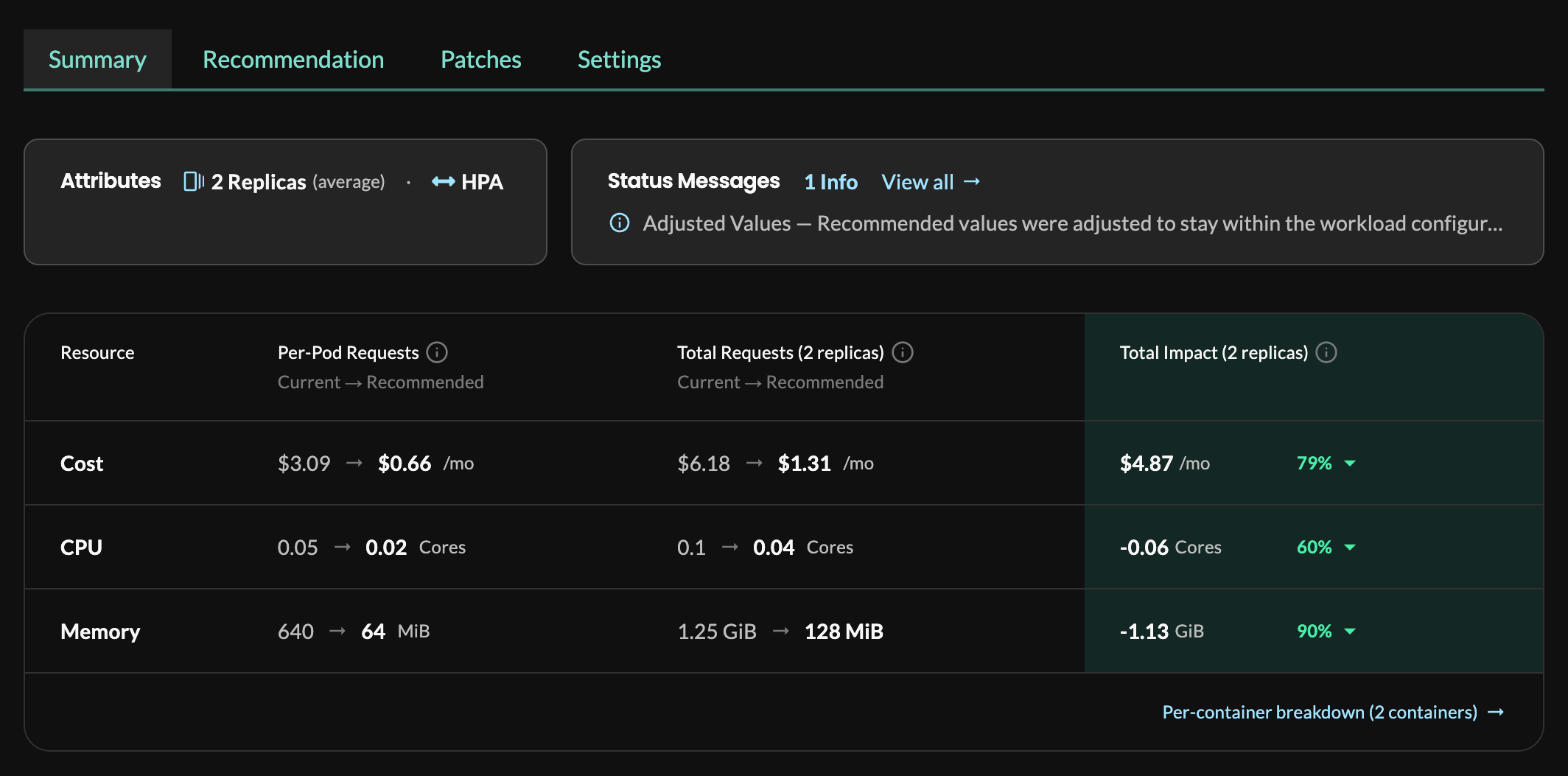
-
GPU optimization (early access)
StormForge now shows GPU usage for workloads that use NVIDIA GPUs: per-workload GPU memory and allocation on the Summary and Recommendation tabs, and device-level activity in a new GPU tab. Requires StormForge Agent 3.2.0 and the new Node Agent, which is disabled by default. See GPU optimization and Node Agent configuration.
August 2026
-
Redesigned Recommendation tab
The Recommendation tab on the workload details page now shows current and recommended requests and limits side by side for each container, with usage sparklines and the percentage change. Expand a container for CPU and memory charts with selectable time ranges, percentile readouts, and OOMKilled and CPU throttling markers.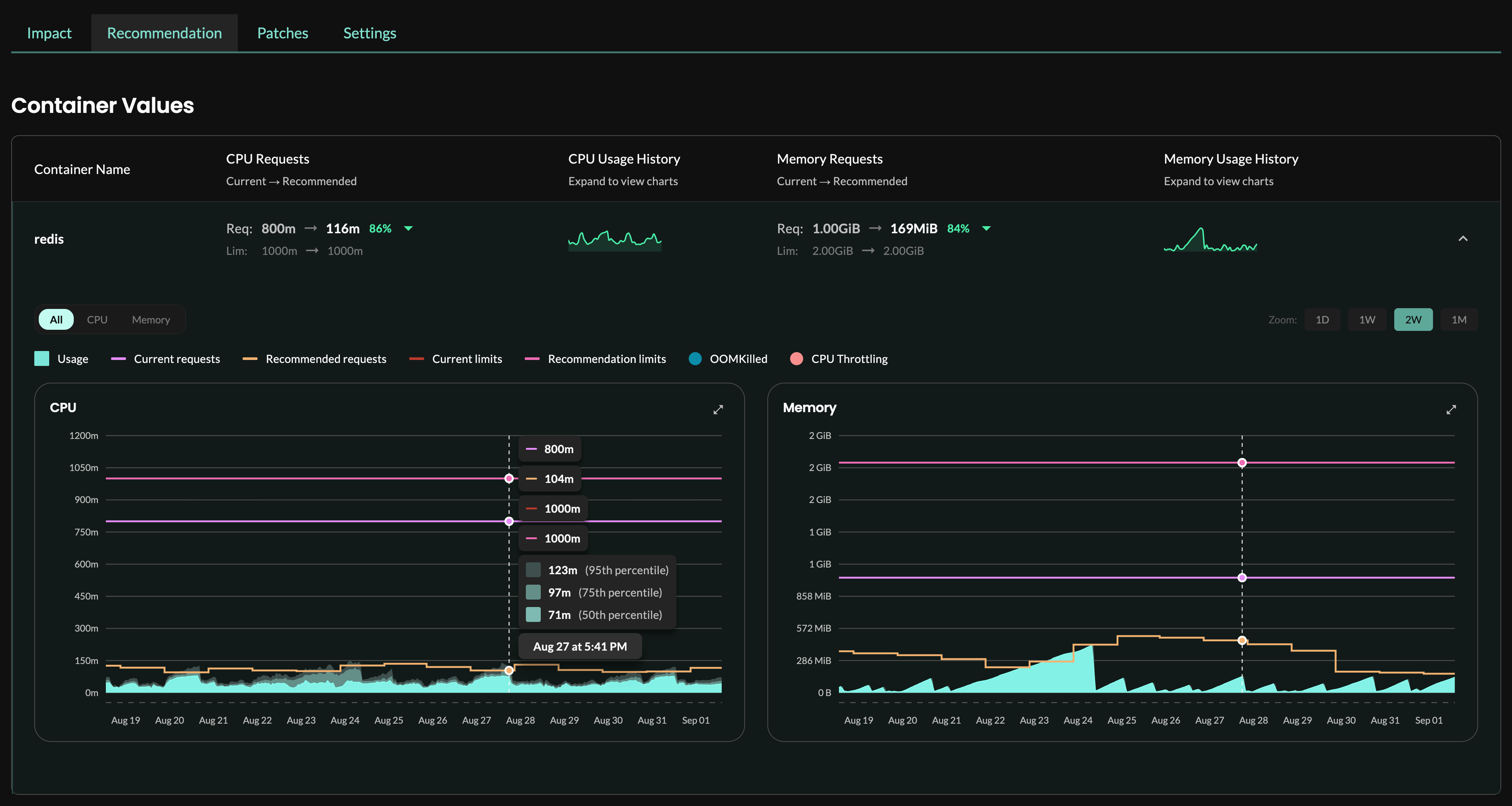
July 2026
-
Schedule time zone shown in workload settings
The Schedule section of a workload’s Settings tab displays the time zone its schedule expressions are evaluated in. -
Workload expiration extended from 14 to 28 days
Workloads that stop reporting now remain available for 28 days before they expire, doubled from the previous 14 days.
June 2026
- StormForge Agent 3.0
A singlestormforgeHelm chart now installs the Agent and Applier together, replacing the separatestormforge-agentchart. Upgrading from v2 is a breaking change that requires migration. See StormForge Agent releases and Migrate v2 to v3.
May 2026
- CPU throttling visibility
The Workloads page includes a CPU throttling column, and the workload details page includes a CPU throttling chart, so you can see which containers are hitting their CPU limits and how often.
March 2026
- HPA settings shown on the workload details page
Workloads managed by a Horizontal Pod Autoscaler now show their HPA settings on the workload details page. See HPA for how StormForge adjusts target utilization when it changes resource requests.
February 2026
- Recommendations applied without restarting Pods
The webhook apply methods now use Kubernetes in-place Pod resizing by default, updating requests and limits on running Pods instead of triggering a rollout. Requires Applier v2.12.0 or later and Kubernetes v1.33 or later; on earlier Kubernetes versions these methods fall back to a rollout or defer the change until the next restart. See Apply settings.